



What scanning is actually for
Scanning exists to stop three expensive events. Cutting a post tension tendon. Drilling through a live conduit. Coring into a void or a service duct that nobody drew. Any one of them turns a two hour task into a variation, a delay and an incident report.
The economics are not close. A scan on a typical commercial floor is a few hundred dollars. Remediating one severed tendon in a post tensioned slab runs into tens of thousands before you count the program impact and the engineer time.
What we can find, and what we cannot
We would rather be straight with you now than on site. Here is the honest boundary.
What GPR finds well
- Reinforcement, top and bottom, with cover depth
- Post tension cables and their drape through the slab
- Electrical and hydraulic conduits cast into the concrete
- Voids, honeycombing and slab thickness
- Whether a slab is solid, ribbed or composite metal deck
What we do not offer
- Locating underground services in the ground. That is a different discipline and a different licence. We scan inside concrete elements.
- Assessing concrete cancer, chloride levels or concrete quality. If that is what you need, our remediation team handles it and we will point you there rather than sell you a scan that will not answer the question.
How a scan runs on site
Before we arrive. We ask for the marked up plan or a photo showing where you want the penetrations. If drawings exist we read them, but we never rely on them alone. Set out drifts, services get added during construction, and as built rarely means as built.
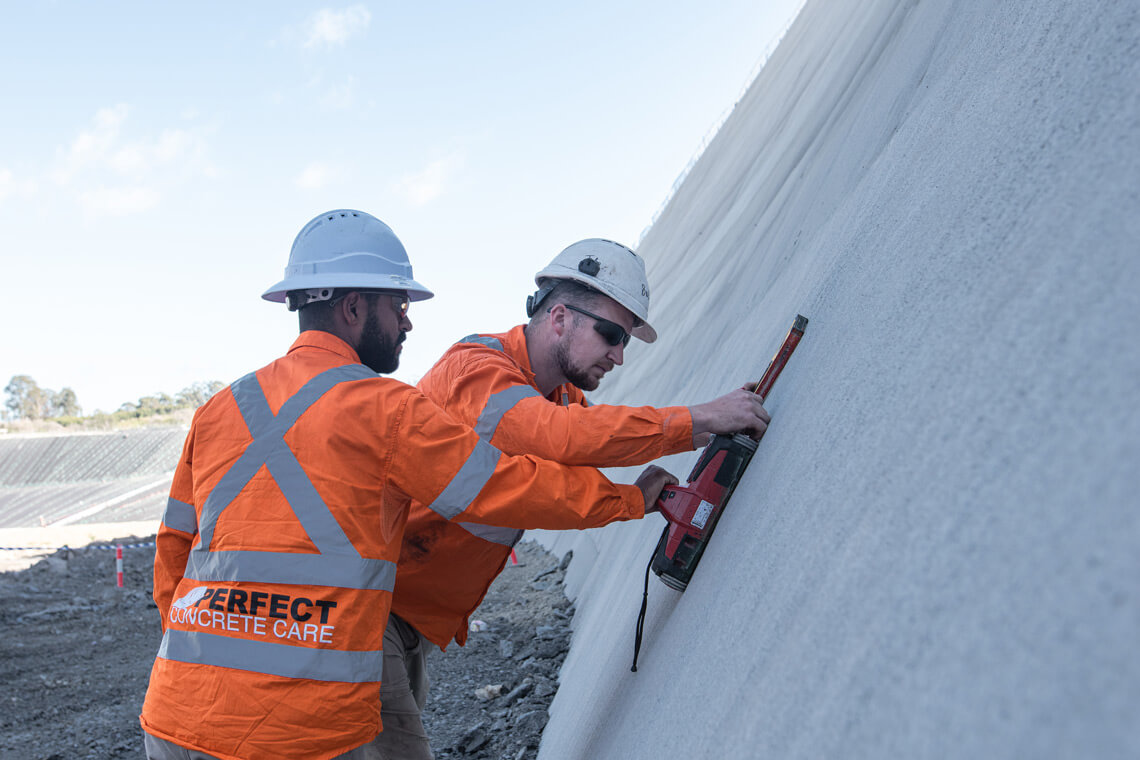
On site. The operator grids the area and runs the antenna in both directions. Reinforcement shows up first, then the deeper items. Anything that reads as a tendon gets confirmed with a second pass at a different angle.
Marking. We paint the reinforcement in one colour and anything you must not touch in another. Safe core locations get a circle and a number. If a requested location cannot be made safe, we mark it clearly and suggest the nearest position that works.
Report. Photos of the marked area, depths, and a plain list of which locations are approved and which are not. Enough for the engineer, short enough that the site manager will actually read it.
A worked example
A fitout contractor needed 34 cores through a post tensioned level three slab for new hydraulic risers. The drawings showed tendon bands running north to south.
The scan found the bands running as drawn, but with two tendons deviating around an old penetration that was not on any drawing. Nine of the 34 requested locations sat directly over a tendon. We moved seven of them between 120mm and 300mm, which the hydraulic designer accepted on the spot. Two could not be moved far enough and were relocated to the adjacent bay after a short conversation with the engineer.
Scanning took most of a day. Nine tendon strikes did not happen. Our crew then cored the approved locations the following morning, which meant one contractor was responsible for both the mark and the hole.
Scan and cut under one contractor
When the scanning company and the cutting company are different businesses, a strike becomes a dispute. Was the mark wrong or was the drill in the wrong place? We do both, so there is one accountable party and one set of records. On live sites and hospitals that is usually the deciding factor.
Where we scan
Sydney, Newcastle, Wollongong and the Central Coast. Brisbane, Ipswich, Logan, the Gold Coast and the Sunshine Coast. For shutdowns and remote plant work we travel.
Common questions
How long does a scan take?
A handful of core locations is usually an hour or two. A full floor plate with dozens of penetrations is a day. We will give you a realistic window when you send the plan.
Does the area need to be clear?
The antenna needs contact with the surface, so we need the floor swept and free of stacked material. Carpet and vinyl are fine. Thick screed reduces clarity and we will tell you if that is the case.
Can you scan walls and soffits?
Yes. Walls, soffits and columns are all scannable, and overhead work is a large part of what we do on fitouts.
What if you find nothing safe?
Then we say so. We would rather tell you a location does not work than mark it and hope. In practice there is nearly always a workable position within a few hundred millimetres.
 Perfect Concrete Care acknowledges the Aboriginal and Torres Strait Islander people as Traditional Custodians of the country on which we live and work. We pay our respects to the Traditional Custodians and Elders past, present and future, and honour their connection to the land and ongoing contribution to society.