

Self-Levelling Floors vs. Concrete Grinding
As Sydney's premiere concrete specialists, the Perfect Concrete Care team is often asked for guidance in a number of uneven floor situations across the residential, commercial and industrial sectors. With more and more clientele opting for masonry finishes but many paths to the same solution, we have put together both sides of the argument for you.
It may sound bleedingly obvious but floors have to be flat and level. Unfortunately, due to a multitude of factors - not all of them are. Perhaps your reno dreams require a different floor height, maybe initial works weren't up to standard, or overtime foundations may have receded. It doesn't matter so much the cause of the uneven floor, what matters is which approach to fix it.
There are essentially two methods. The first one is to increase the low areas to match the high areas. Or the reverse. Decrease the high areas to match the low areas. With the low spots, the difference usually is not enough to be able to pour fresh concrete on top of that would simply be our advice. Minute differences require special attention, so self-leveling floor compounds are used to bring sunken areas up. But if you can't - or don't want to - raise the lower areas up then the only alternative is to grind the high areas down. Both methods have their place, both have their advantages and disadvantages and both will work. It's just a question of where and when.
Floor Levelling.
Also known as self-leveling concrete is a polymer-modified extremely high flow compound that - as the name suggests - levels itself. Prior to curing it has the viscosity of pancake batter and with a simple rake and smoother, the material is quickly and easily spread into place. It requires very little preparation. Other than a quick vacuum of the area and short use of a mixer - it requires no external power. It does require water though as well as a thorough understanding of working materials.
Laying 20m2 will take between 1-4 hours depending on access and other factors. Once the compound cures it is almost perfectly smooth and has a compressive strength similar to or better than traditional concrete. This makes it perfect for interiors and low-traffic exteriors. Unfortunately, this is not the end product as it will still require some kind of finishing like tiles or carpet. Sika is arguably the best brand on the market so that's what we use.
Advantages - Requires no extended use of power, quiet operation.
Disadvantages - Chemical compounds, once you begin can't stop, not great at high/heavy-traffic areas for extended periods.
Concrete Grinding.
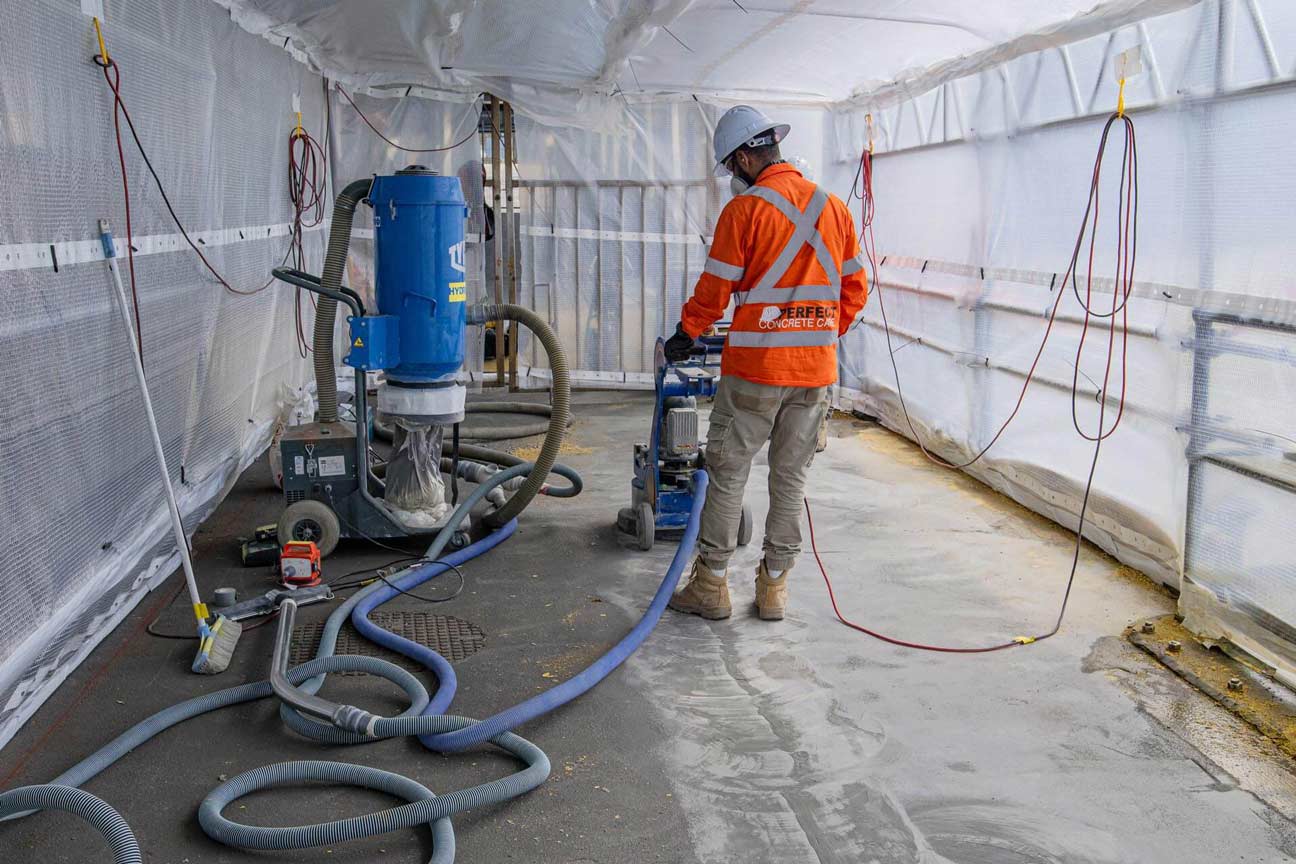
Floor grinding is exactly that - using an electric machine to grind the floor until it is the required height. It requires the use of no compounds or binaries but requires more floor prep in that if the variance between high and low is over 4mm - it will need jackhammering/scarifying first. The machine is heavy, both physically and in terms of electricity use - so there are some constraints there. But the surface is as strong as concrete [because it is concrete] so it is also good for exteriors, even where heavy vehicles are involved. Dust is a by-product of the grinding process, and whilst 95% of the stuff is captured by vacuum - it's not completely airtight. Grinding 20m2 wholly depends on numerous factors, but the exposed aggregate can be the end product so no further finishing is required.
Advantages - No chemical compounds, you can stop at any time, great for high/heavy-traffic areas for extended periods.
Disadvantages - Requires extended periods of electricity, can be quite noisy.
Of course, if one area of your floor is too low and another too high then both methods can be used in conjunction with one another. You would however have to tile or carpet. The grinding is essential for material removal, not for exposing any aggregate.
Perfect Concrete Care has expertise in the delivery of both methods. Contact us today for a site visit and quote and we will steer you in the right direction.
Need a price on this work?
Send us the scope and we will come back to you with a price. Commercial and industrial work only.


 Perfect Concrete Care acknowledges the Aboriginal and Torres Strait Islander people as Traditional Custodians of the country on which we live and work. We pay our respects to the Traditional Custodians and Elders past, present and future, and honour their connection to the land and ongoing contribution to society.