


Concrete scanning in Newcastle: GPR to find steel, post tension cables and conduits before cutting
- GPR to find steel, post tension cables and conduits before cutting
- Reinforcement, tendons, conduits, voids and slab thickness
- The technician marks the slab with paint and the safe zone
- Depth read off the scan and written next to the mark
- The same company scans, cores and cuts
- We do not locate underground services in the ground
Yes. We scan concrete in Newcastle. GPR to find the steel, post tension cables and conduits inside a slab or wall before anyone cuts, cores or drills into it.
If you are about to core, cut, drill or anchor into a concrete slab, wall or beam in Newcastle and you do not know what is inside it, Perfect Concrete Care scans it first. We use ground penetrating radar to locate reinforcement, post tension cables, electrical conduits and voids, mark the slab, and give you a safe zone to work in. Most of the time we then do the coring or cutting ourselves on the same visit.
Newcastle enquiries: call 02 8015 6398 or use the form at the bottom of this page. Our Sydney team run the job from our Marrickville base, and Hunter jobs are booked as a block so the scan and the coring happen on one trip.

What we find in Newcastle
Reinforcement. Bar spacing, cover and layers, so a core hole or anchor goes between bars rather than through them.
Post tension cables and ducts. The one thing you cannot afford to hit. We locate the tendons and their depth and mark a clear path. Where a penetration cannot avoid a tendon, the job becomes tendon truncation and needs an engineer, and we do that too.
Conduits and services in the slab. Electrical conduits, hydraulic pipes and data runs cast into the concrete, the things that shut a floor down when a core drill goes through them.
Voids, slab thickness and cover. For engineers assessing an existing structure, working out load capacity, or checking that a block wall or a slab was built to the drawings.
Where this work happens in Newcastle
Newcastle CBD and Honeysuckle, the John Hunter precinct, the university, Kotara and Charlestown, Mayfield and Carrington, Lake Macquarie, Maitland and the Hunter Valley. Live buildings, hospitals, rail and airport sites, occupied offices and trading retail, where a service strike costs far more than the scan.
How we scan
We use the Hilti PS1000 X-Scan system, which gives a live image of what is inside the concrete on site rather than a recording to interpret later. The technician scans the area, reads the image, and marks the slab or wall with paint: steel, cables, conduits, and the safe zone for each hole or cut. Depth is read off the scan and written next to the mark.
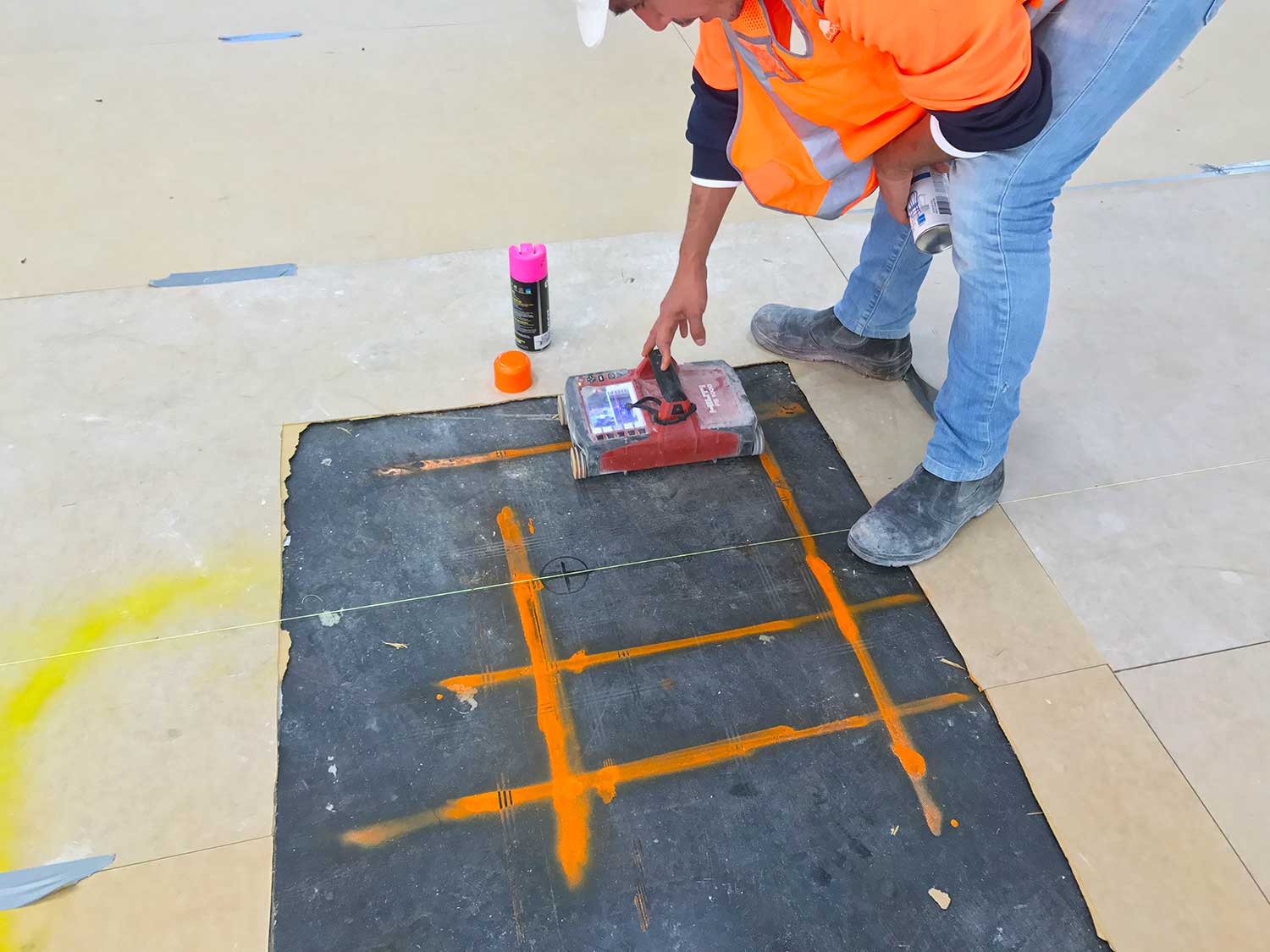
Because the same company does the core drilling and concrete cutting, the scan is not a separate trade to coordinate. The technician who marks the slab can be the operator who cores it, and the responsibility for not hitting anything sits in one place.
What we do not do
We do not assess concrete quality, strength or concrete cancer, and we do not locate underground services in the ground. GPR looks inside the concrete, not at its condition, and not below the slab into soil. If you are a builder, electrician, plumber, fit out contractor, facilities manager or engineer with a slab or wall that needs to be scanned before it is cut, cored or anchored, you are in the right place.
Common questions
Can you scan for concrete cancer or check the quality of the concrete?
No. GPR shows what is inside the slab: steel, cables, conduits, voids and thickness. It does not measure concrete strength, carbonation, chloride or corrosion. If you suspect concrete cancer you need a structural engineer and testing, and we can repair what they find.
Do you locate underground pipes and cables in the ground?
No. We scan inside concrete slabs, walls and beams. Buried services in soil are a Dial Before You Dig and utility locating job, which is a different trade with different equipment.
How long does a scan take in Newcastle?
A handful of core holes is usually under an hour on site, including the mark out. A full slab survey for an engineer takes longer and comes with a report. If we are also coring or cutting, the scan is done first on the same visit.
What do we get at the end?
Clear marks on the slab showing reinforcement, post tension cables and conduits with their approximate depth, a safe zone for each hole or cut, and photos. Where the job needs it, a written report with the scan images for the engineer.
Other areas we cover
This page is about Newcastle. We also scan concrete in Sydney, Wollongong, Brisbane, Gold Coast and Sunshine Coast. For the full service overview see concrete scanning.
Post tensioned slab cutting by city
Where a penetration has to go through a post tensioned slab, we scan, open, truncate and reinstate the tendons to your structural engineer's design. City pages: Sydney, Wollongong, Newcastle, Brisbane, Gold Coast and Sunshine Coast.
What happens next
Call 02 8015 6398 or send the form below with the address, how many holes or cuts, and what the slab is (suspended, post tensioned, on ground). Our Sydney team will come back to you the same business day with a time and a price. Small scans can usually be done within a day or two.
Need a price on this work?
Send us the scope and we will come back to you with a price. Commercial and industrial work only.
 Perfect Concrete Care acknowledges the Aboriginal and Torres Strait Islander people as Traditional Custodians of the country on which we live and work. We pay our respects to the Traditional Custodians and Elders past, present and future, and honour their connection to the land and ongoing contribution to society.